Technology insight for the enterprise, Breaking Science and Technology News

Showing posts with label Technology. Show all posts

Wednesday, December 16, 2015

Rice Engineers Develop Light-Driven Nanosubmarines

Rice Develops Light-Driven Nanosubmarines
(Illustration by Loïc Samuel/Rice University)
Scientists at Rice University have created single-molecule submersibles that contain just 244 atoms and are powered by ultraviolet light.
Though they’re not quite ready for boarding a lá “Fantastic Voyage,” nanoscale submarines created at Rice University are proving themselves seaworthy.
Each of the single-molecule, 244-atom submersibles built in the Rice lab of chemist James Tour has a motor powered by ultraviolet light. With each full revolution, the motor’s tail-like propeller moves the sub forward 18 nanometers.
And with the motors running at more than a million RPM, that translates into speed. Though the sub’s top speed amounts to less than 1 inch per second, Tour said that’s a breakneck pace on the molecular scale.
“These are the fastest-moving molecules ever seen in solution,” he said.
Expressed in a different way, the researchers reported this month in the American Chemical Society journal Nano Letters that their light-driven nanosubmersibles show an “enhancement in diffusion” of 26 percent. That means the subs diffuse, or spread out, much faster than they already do due to Brownian motion, the random way particles spread in a solution.
While they can’t be steered yet, the study proves molecular motors are powerful enough to drive the sub-10-nanometer subs through solutions of moving molecules of about the same size.
“This is akin to a person walking across a basketball court with 1,000 people throwing basketballs at him,” Tour said.
Tour’s group has extensive experience with molecular machines. A decade ago, his lab introduced the world to nanocars, single-molecule cars with four wheels, axles and independent suspensions that could be “driven” across a surface.
Tour said many scientists have created microscopic machines with motors over the years, but most have either used or generated toxic chemicals. He said a motor that was conceived in the last decade by a group in the Netherlands proved suitable for Rice’s submersibles, which were produced in a 20-step chemical synthesis.
“These motors are well-known and used for different things,” said lead author and Rice graduate student Victor García-López. “But we were the first ones to propose they can be used to propel nanocars and now submersibles.”
The motors, which operate more like a bacteria’s flagellum than a propeller, complete each revolution in four steps. When excited by light, the double bond that holds the rotor to the body becomes a single bond, allowing it to rotate a quarter step. As the motor seeks to return to a lower energy state, it jumps adjacent atoms for another quarter turn. The process repeats as long as the light is on.
For comparison tests, the lab also made submersibles with no motors, slow motors and motors that paddle back and forth. All versions of the submersibles have pontoons that fluoresce red when excited by a laser, according to the researchers. (Yellow, sadly, was not an option.)
Chemical Schematic Shows the Design of Single-Molecule Nanosubmersibles
A chemical schematic shows the design of single-molecule nanosubmersibles created at Rice University. The sub’s fluorescent pontoons are blue; the motor is red. (Illustration by Victor García-López/Rice University)
“One of the challenges was arming the motors with the appropriate fluorophores for tracking without altering the fast rotation,” García-López said.
Once built, the team turned to Gufeng Wang at North Carolina State University to measure how well the nanosubs moved.
“We had used scanning tunneling microscopy and fluorescence microscopy to watch our cars drive, but that wouldn’t work for the submersibles,” Tour said. “They would drift out of focus pretty quickly.”
The North Carolina team sandwiched a drop of diluted acetonitrile liquid containing a few nanosubs between two slides and used a custom confocal fluorescence microscope to hit it from opposite sides with both ultraviolet light (for the motor) and a red laser (for the pontoons).
The microscope’s laser defined a column of light in the solution within which tracking occurred, García-López said. “That way, the NC State team could guarantee it was analyzing only one molecule at a time,” he said.
Rice’s researchers hope future nanosubs will be able to carry cargoes for medical and other purposes. “There’s a path forward,” García-López said. “This is the first step, and we’ve proven the concept. Now we need to explore opportunities and potential applications.”
Co-authors of the paper are Rice alumnus Pinn-Tsong Chiang and postdoctoral researcher Gedeng Ruan; North Carolina State graduate student Fang Chen; Angel Martí, an associate professor of chemistry, of bioengineering and of materials science and nanoengineering, and Anatoly Kolomeisky, a professor of chemistry and of chemical and biomolecular engineering, both at Rice.
Wang is an assistant professor of analytical chemistry at North Carolina State. Tour is the T.T. and W.F. Chao Chair in Chemistry as well as a professor of computer science and of materials science and nanoengineering.
The National Science Foundation, the National Institutes of Health, the Welch Foundation and North Carolina State supported the research.
Publication: Víctor García-López, et al., “Unimolecular Submersible Nanomachines. Synthesis, Actuation, and Monitoring,” Nano Letters, 2015; DOI:10.1021/acs.nanolett.5b03764
Source: Mike Williams, Rice Universality
‘Chemical Laptop’ Could Be Used to Search for Life Beyond Earth

Miniaturized Laboratory Computer Could Search for Signs of Life Outside Earth
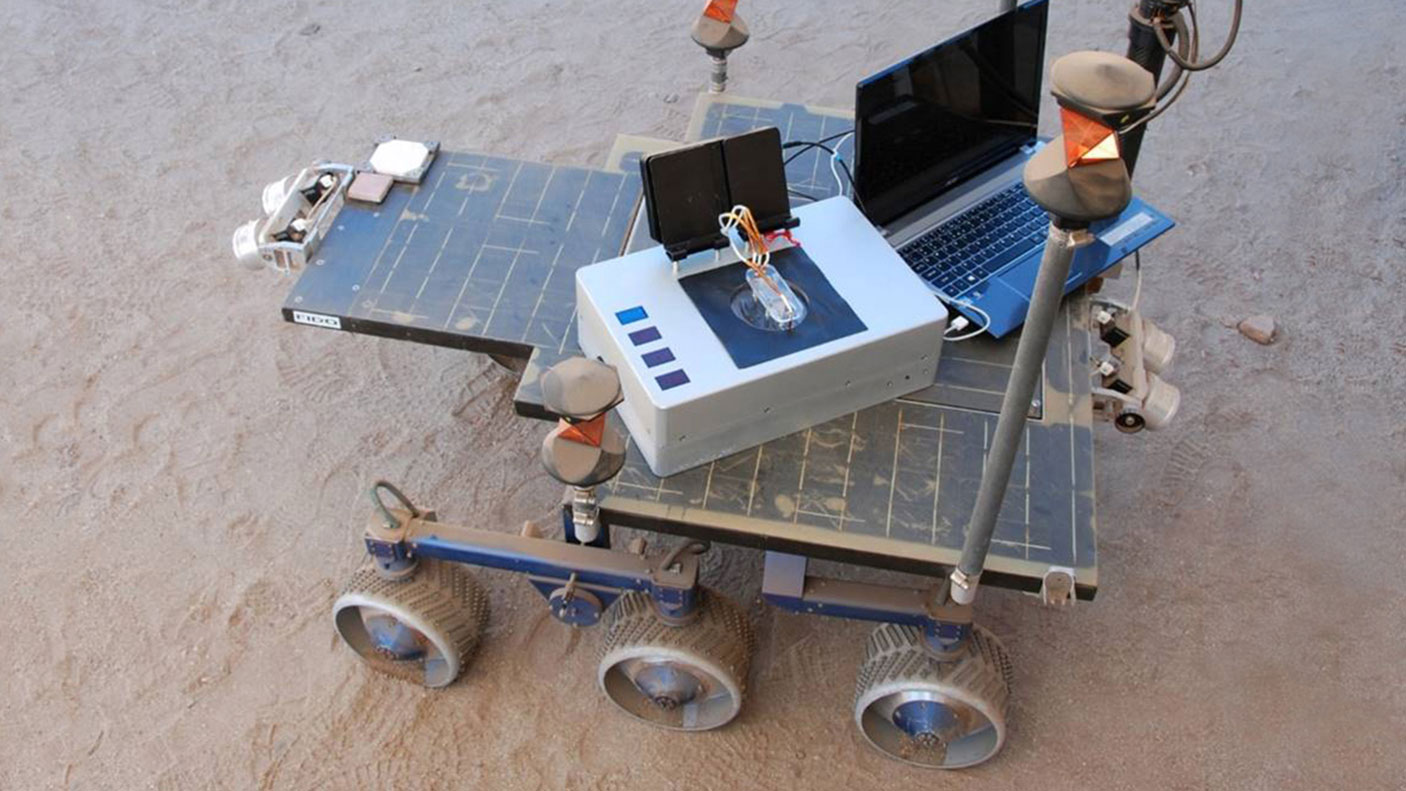
Researchers took the Chemical Laptop to JPL’s Mars Yard, where they placed the device on a test rover. This image shows the size comparison between the Chemical Laptop and a regular laptop. Credits: NASA/JPL-Caltech
Scientists have developed a miniaturized laboratory, called Chemical Laptop, that could be used to search for signs of life outside Earth.
If you were looking for the signatures of life on another world, you would want to take something small and portable with you. That’s the philosophy behind the “Chemical Laptop” being developed at NASA’s Jet Propulsion Laboratory in Pasadena, California: a miniaturized laboratory that analyzes samples for materials associated with life.
“If this instrument were to be sent to space, it would be the most sensitive device of its kind to leave Earth, and the first to be able to look for both amino acids and fatty acids,” said Jessica Creamer, a NASA postdoctoral fellow based at JPL.
Like a tricorder from “Star Trek,” the Chemical Laptop is a miniaturized on-the-go laboratory, which researchers hope to send one day to another planetary body such as Mars or Europa. It is roughly the size of a regular computing laptop, but much thicker to make room for chemical analysis components inside. But unlike a tricorder, it has to ingest a sample to analyze it.
“Our device is a chemical analyzer that can be reprogrammed like a laptop to perform different functions,” said Fernanda Mora, a JPL technologist who is developing the instrument with JPL’s Peter Willis, the project’s principal investigator. “As on a regular laptop, we have different apps for different analyses like amino acids and fatty acids.”
Amino acids are building blocks of proteins, while fatty acids are key components of cell membranes. Both are essential to life, but can also be found in non-life sources. The Chemical Laptop may be able to tell the difference.
What it’s looking for
Amino acids come in two types: Left-handed and right-handed. Like the left and right hands of a person, these amino acids are mirror images of each other but contain the same components. Some scientists hypothesize that life on Earth evolved to use just left-handed amino acids because that standard was adopted early in life’s history, sort of like the way VHS became the standard for video instead of Betamax in the 1980s. It’s possible that life on other worlds might use the right-handed kind.
“If a test found a 50-50 mixture of left-handed and right-handed amino acids, we could conclude that the sample was probably not of biological origin,” Creamer said. “But if we were to find an excess of either left or right, that would be the golden ticket. That would be the best evidence so far that life exists on other planets.”
The analysis of amino acids is particularly challenging because the left- and right-handed versions are equal in size and electric charge. Even more challenging is developing a method that can look for all the amino acids in a single analysis.
When the laptop is set to look for fatty acids, scientists are most interested in the length of the acids’ carbon chain. This is an indication of what organisms are or were present.
How it works
The battery-powered Chemical Laptop needs a liquid sample to analyze, which is more difficult to obtain on a planetary body such as Mars. The group collaborated with JPL’s Luther Beegle to incorporate an “espresso machine” technology, in which the sample is put into a tube with liquid water and heated to above 212 degrees Fahrenheit (100 degrees Celsius). The water then comes out carrying the organic molecules with it. The Sample Analysis at Mars (SAM) instrument suite on NASA’s Mars Curiosity rover utilizes a similar principle, but it uses heat without water.
Once the water sample is fed into the Chemical Laptop, the device prepares the sample by mixing it with a fluorescent dye, which attaches the dye to the amino acids or fatty acids. The sample then flows into a microchip inside the device, where the amino acids or fatty acids can be separated from one another. At the end of the separation channel is a detection laser. The dye allows researchers see a signal corresponding to the amino acids or fatty acids when they pass the laser.
Inside a “separation channel” of the microchip, there are already chemical additives that mix with the sample. Some of these species will only interact with right-handed amino acids, and some will only interact with the left-handed variety. These additives will change the relative amount of time the left and right-handed amino acids are in the separation channel, allowing scientists to determine the “handedness” of amino acids in the sample.
Chemical Laptop Analyzes Liquid Samples and Detects Amino Acids and Fatty Acids
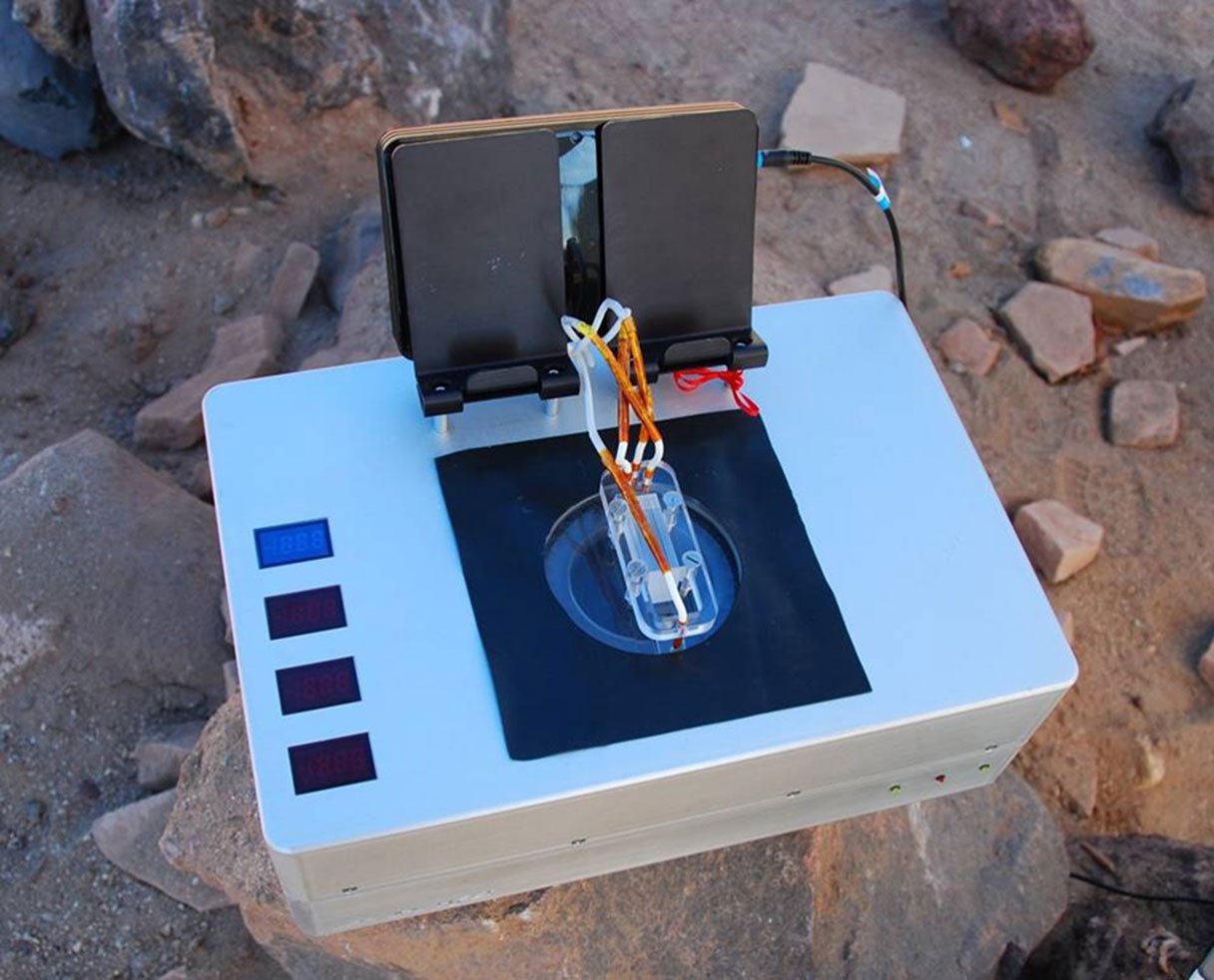
The Chemical Laptop, developed at JPL, analyzes liquid samples and detects amino acids and fatty acids. These are both chemicals that are essential to life. Credits: NASA/JPL-Caltech
Testing for future uses
Last year the researchers did a field test at JPL’s Mars Yard, where they placed the Chemical Laptop on a test rover.
“This was the first time we showed the instrument works outside of the laboratory setting. This is the first step toward demonstrating a totally portable and automated instrument that can operate in the field,” said Mora.
For this test, the laptop analyzed a sample of “green rust,” a mineral that absorbs organic molecules in its layers and may be significant in the origin of life, said JPL’s Michael Russell, who helped provide the sample.
“One ultimate goal is to put a detector like this on a spacecraft such as a Mars rover, so for our first test outside the lab we literally did that,” said Willis.
Since then, Mora has been working to improve the sensitivity of the Chemical Laptop so it can detect even smaller amounts of amino acids or fatty acids. Currently, the instrument can detect concentrations as low as parts per trillion. Mora is currently testing a new laser and detector technology.
Coming up is a test in the Atacama Desert in Chile, with collaboration from NASA’s Ames Research Center, Moffett Field, California, through a grant from NASA’s Planetary Science & Technology Through Analog Research (PSTAR) program.
“This could also be an especially useful tool for icy-worlds targets such as Enceladus and Europa. All you would need to do is melt a little bit of the ice, and you could sample it and analyze it directly,” Creamer said.
The Chemical Laptop technology has applications for Earth, too. It could be used for environmental monitoring — analyzing samples directly in the field, rather than taking them back to a laboratory. Uses for medicine could include testing whether the contents of drugs are legitimate or counterfeit.
Creamer recently won an award for her work in this area at JPL’s Postdoc Research Day Poster Session.
NASA’s PICASSO program, part of the agency’s Science Mission Directorate in Washington, supported this research. The California Institute of Technology in Pasadena manages JPL for NASA.
Source: Elizabeth Landau, NASA’s Jet Propulsion Laboratory

Scientists Develop “Kill Switches” for Engineered Bacteria

Scientists Develop “Kill Switches” for Engineered Bacteria

Engineered Bacteria with Kill Switches
To prevent genetically modified bacteria from escaping into the wider environment, MIT researchers have developed safeguards in the form of two so-called “kill switches,” which they call “Deadman” and “Passcode.” These kill switches can cause synthetic bacteria to die without the presence of certain chemicals.
Many research teams are developing genetically modified bacteria that could one day travel around parts of the human body, diagnosing and even treating infection. The bugs could also be used to monitor toxins in rivers or to improve crop fertilization.
However, before such bacteria can be safely let loose, scientists will need to find a way to prevent them from escaping into the wider environment, where they might grow and cause harm.
To this end, researchers at MIT, the Broad Institute of MIT and Harvard, and the Wyss Institute at Harvard University have developed safeguards in the form of two so-called “kill switches,” which can cause the synthetic bacteria to die without the presence of certain chemicals.
In a paper published this week in the journal Nature Chemical Biology, the researchers describe their two kill switches, which they call “Deadman” and “Passcode.”
Stand-alone circuits
There have been a number of attempts to develop kill switches over the past year, according to James Collins, the Termeer Professor of Medical Engineering and Science in MIT’s Department of Biological Engineering and Institute for Medical Engineering and Science (IMES), who led the research.
These include efforts to reprogram the entire genome of the organism to ensure that it requires the presence of certain amino acids or other chemicals in order to survive, divide, and grow.
However, this approach can be both labor- and resource-intensive, and could introduce changes that might make the organism less useful as a monitoring or diagnostic tool, Collins says.
“In our case, we are introducing standalone circuits that can be popped in to any number of different organisms, without needing to rewire or change much of the genome in order for it to accommodate the switch,” he says.
The Deadman switch, for example, is part of a bacterial strain that needs an external chemical to prevent a continuously expressed toxin from killing the cell.
The switch was motivated by the so-called deadman brakes on old trains, which required a conductor to be in constant contact with the handle or pedal in order for the vehicle to move forwards, Collins says.
The system, which builds on previous work in Collin’s lab, consists of a genetic “toggle” switch made up of two transcription factor genes.
The switch can flip between two states, in which either one of the two transcription factor genes is turned on. The researchers altered the expression of these two transcription factors, leading to strong expression for one gene and weak expression for the other.
The presence of a small molecule keeps the switch in its weak state, but as soon as this is removed, the switch will flip to its strong state. The switch is programmed to express various toxins as soon as this strong state is turned on, Collins says.
“If the system does get flipped, by removing the small molecule, it would express toxins at a very high level that could then quite rapidly and readily kill off the bug,” he says.
A cellular logic gate
The Passcode switch, in contrast, acts like a logic gate in that it requires a specific combination of several chemical inputs in order to enable the genetically modified bacteria to survive and proliferate.
The switch consists of a set of modular transcription factors that contain separate domains for sensing small molecules — the inputs — and for regulating gene expression. By mixing and matching these functional domains, the researchers are able to construct hybrid transcription factors in which different small molecule inputs are linked to the control of a specific promoter for gene expression.
If the transcription factors detect that the right combination of small molecules are present in the environment, then the bacteria will survive. But if the correct combination of input signals is not present, the switch kills the bug, according to the paper’s lead author Clement Chan, a postdoc in Collin’s laboratory.
“If any of the required inputs are not correct, then the bug will die,” he says.
By using different transcription factors, the researchers can change the passcode combination of small molecules needed for the cell to survive. In this way the switches can be easily changed to meet the needs of different applications, Chan says.
“It makes our biocontainment system much more flexible, so you can apply the passcode system in a much wider range of applications.”
The switches could also be used to protect a company’s intellectual property, Chan says.
“Imagine that you own a certain bug, and you don’t want your competitors to use it. Then you could incorporate this device so that only people who know the passcode can use your bug,” he says.
Even if a competitor somehow managed to get hold of the passcode, the researcher could simply change it by using different transcription factors, he says.
Scaling up
The new safeguards have exciting possibilities for scaling kill switches in two important directions, according to Farren Isaacs, an assistant professor in the Systems Biology Institute at Yale University, who was not involved in the research.
First, they establish the feasibility of using kill switches across diverse species, Isaacs says.
“They also expand the passcode switches to a large combination of synthetic molecules and transcription factors for many unique sets of biocontained strains and customized cocktails of synthetic small molecules,” he adds.
Having successfully tested the two kill switches in Escherichia coli, the researchers are now hoping to incorporate them into living diagnostic or therapeutic tools, designed to target a variety of bacterial infections, Collins says.
Publication: Clement T Y Chan, et al., “‘Deadman’ and ‘Passcode’ microbial kill switches for bacterial containment,” Nature Chemical Biology, 2015; doi:10.1038/nchembio.1979
Source: Helen Knight, MIT News

Most Popular

CATEGORIES